
Table of Contents
- What Makes Sustainable Kids Clothing Different
- The Slow Fashion Benefits for Families
- Organic Cotton Kids Clothes: Why They Matter
- How to Build a Kids Capsule Wardrobe
-
10 Best Sustainable Kids Clothing Options
- 1. Birch & Co. Organic Cotton Kids T-Shirt
- 2. Birch & Co. Essential Kids' Fleece Hoodie
- 3. Birch & Co. Essential Fleece Kids' Crewneck Sweatshirt
- 4. Birch & Co. Kid's Drop Shoulder Long Sleeve T-Shirt
- 5. Birch & Co. Essential Kids' Fleece Jogged Sweatpants
- 6. Birch & Co. Kids' Crewneck T-Shirt
- 7. Birch & Co. Vintage Wash Kids' T-Shirt
- 8. Birch & Co. Essential Kids' T-Shirt
- Cost-Per-Wear: Why Sustainable Clothing Saves Money
- Certifications and Standards to Look For
- Resale and Circularity: Extending Garment Life
Last Updated: August 28, 2026
What Makes Sustainable Kids Clothing Different
Sustainable kids clothing prioritizes quality, durability, and ethical production over fast-fashion trends. The difference lies in material sourcing, manufacturing practices, and garment longevity. Sustainable brands create timeless essentials using natural fibers like organic cotton, bamboo viscose, or linen, grown without synthetic pesticides and processed with minimal chemical intervention. These pieces are gentler on sensitive skin, biodegradable at end-of-life, and produced with significantly lower environmental impact than conventional textiles.

Ethical production means fair wages, safe working conditions, and transparent supply chains. Many sustainable brands minimize textile waste by using pre-consumer scraps or designing garments with minimal cutting waste. This attention throughout production means higher upfront costs, but clothing that actually lasts, critical when dressing growing children.
The Slow Fashion Benefits for Families
Slow fashion simplifies daily routines and reduces decision fatigue. When your child has fewer, higher-quality basics that coordinate, getting dressed becomes effortless. A capsule wardrobe of 20-25 quality pieces can outfit a child for an entire season, whereas fast fashion requires constant replenishment.
The financial benefits are substantial. A $35 sustainable piece that survives 200 washes costs $0.18 per wear, compared to a $10 fast-fashion shirt deteriorating after 20 washes at $0.50 per wear (peer-reviewed research). When buying for multiple children across years, those savings compound significantly.
Slow fashion also reduces laundry volume, extends time between washes, and eliminates guilt about discarded clothing. Sustainable pieces are designed to be passed down to siblings, resold, or donated when truly worn out.
Organic Cotton Kids Clothes: Why They Matter
Organic cotton is grown without synthetic pesticides, herbicides, or genetically modified seeds. This matters significantly for children, whose skin is more permeable and sensitive than adult skin (peer-reviewed research). Conventional cotton production uses approximately 16% of global pesticides despite occupying only 2.5% of cultivated land (fao.org). Organic cotton kids clothes eliminate this exposure entirely, offering softer, more breathable, naturally hypoallergenic fabric ideal for children with eczema, asthma, or general skin sensitivity.
Organic cotton is grown in healthier soil, resulting in stronger, longer fibers that hold shape, resist pilling, and maintain color through repeated washing. A quality organic cotton t-shirt can survive three to four children and still look presentable, justifying the higher price point.
Birch & Co.'s Organic Cotton Kids T-Shirt at $39.99 exemplifies this quality standard. Made from 100% organic ring-spun combed cotton with a substantial 4.57 oz/yd² fabric weight, it's designed to survive childhood adventures. The set-in sleeves and narrow double-needle topstitching prevent unraveling and extend garment life significantly.
How to Build a Kids Capsule Wardrobe
Building a kids capsule wardrobe means selecting 15-25 versatile pieces that coordinate with each other, eliminate decision-making, and reduce laundry volume.
Start with neutral base colors: white, black, grey, navy, and natural beige. Add one or two accent colors that reflect your child's personality. Limit yourself to this color palette strictly, every new piece should work with everything already in the wardrobe.
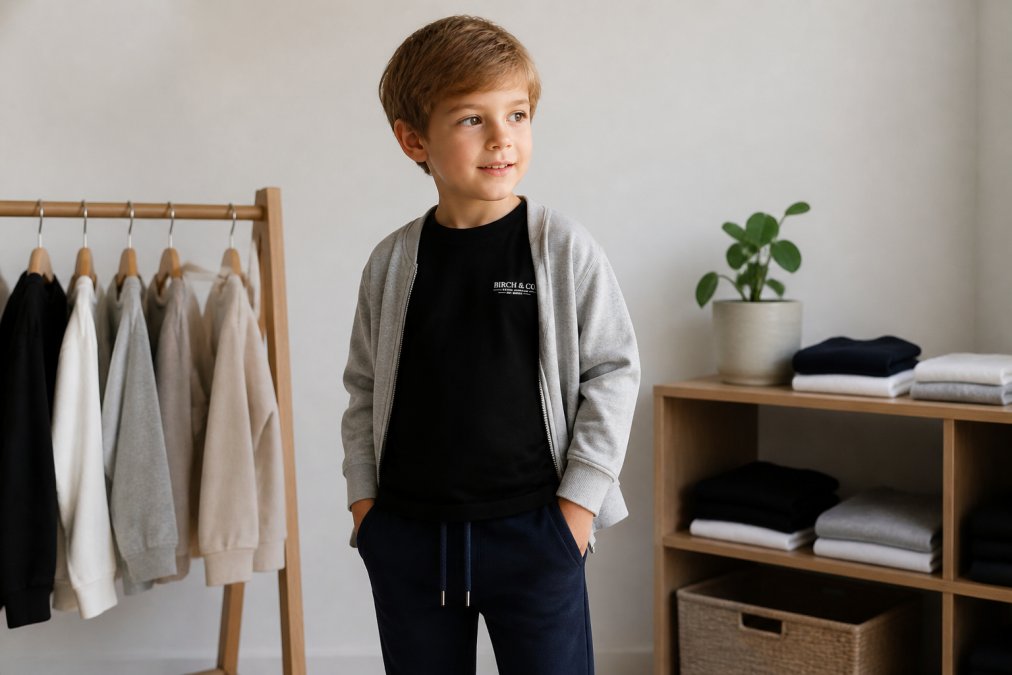
The foundation pieces should include:
- 3-4 basic t-shirts in neutral colors
- 2-3 long-sleeve layering shirts
- 1-2 lightweight sweaters or crewnecks
- 1 warm hoodie or fleece jacket
- 2-3 pairs of pants
- 1-2 shorts for summer
- 1-2 lightweight layers for transitional seasons
- 1 warm outerwear piece for winter
The Birch & Co. Essential Kids' T-Shirt ($32.99) and Essential Fleece Kids' Crewneck Sweatshirt ($44.99) form ideal foundations. Both use substantial natural fabrics and coordinate with everything. The Essential Kids' Fleece Jogged Sweatpants ($44.00) complete the base layer.

Prioritize versatility over novelty. A plain crewneck worn 100 times is more valuable than a printed tee worn twice. Avoid character prints, trendy patterns, or limited-edition designs, these date quickly and limit mixing potential.
10 Best Sustainable Kids Clothing Options
1. Birch & Co. Organic Cotton Kids T-Shirt, $39.99
Made from 100% organic ring-spun combed cotton with a substantial 4.57 oz/yd² fabric weight, this piece is engineered to survive multiple children. The set-in sleeves and self-fabric neck tape prevent common failure points where cheap t-shirts unravel. The medium fit offers room for growth without looking oversized.
What sets this apart: the fabric weight. This uses commercial-grade weight typically found in premium adult essentials. Sizing runs small compared to mainstream brands, so ordering a size up is recommended.
2. Birch & Co. Essential Kids' Fleece Hoodie, $54.99
This heavyweight fleece hoodie at 365 g/m² with a brushed interior delivers genuine insulation without bulk. The 69% polyester, 31% cotton blend balances durability with breathability. Ribbed cuffs and hem prevent stretching. The spacious kangaroo pocket actually fits small hands. The adjustable hood fits properly without slipping.
This hoodie pairs effortlessly with capsule wardrobe basics. The unisex design works for any child, and minimal branding means it won't look dated in two years.
3. Birch & Co. Essential Fleece Kids' Crewneck Sweatshirt, $44.99
This crewneck occupies the sweet spot between a t-shirt and hoodie. Made from 86.7% cotton, 13.3% polyester at 365 g/m² (10.8 oz/yd²), it's warm enough for transitional seasons without requiring a full winter coat. The cotton-rich blend breathes better than pure polyester fleece, reducing overheating during active play.
The classic crew neckline won't stretch out, minimal detailing keeps it timeless, and the relaxed fit accommodates growth. This is more versatile than a hoodie for school, weekend adventures, and casual family outings.
4. Birch & Co. Kid's Drop Shoulder Long Sleeve T-Shirt, $34.99
The drop-shoulder silhouette offers modern styling without sacrificing durability. Made from 94% cotton, 6% spandex at 220 GSM, it's lightweight enough for layering but substantial enough to survive regular washing. The spandex content adds genuine stretch for free movement during play.
This piece works as a standalone layer or as a base under sweaters. The relaxed fit accommodates different body types without looking oversized.
5. Birch & Co. Essential Kids' Fleece Jogged Sweatpants, $44.00
These joggers use the same 365 g/m² heavyweight fleece as the hoodie, ensuring they won't thin out or pill. The 86.7% cotton, 13.3% polyester blend breathes better than pure polyester. Reinforced seams at stress points, an elastic waistband that doesn't dig in, and tapered ankles that stay in place prevent common failure points.
For capsule wardrobes, quality sweatpants are essential. They work for school, weekend play, and travel while still looking intentional.
6. Birch & Co. Kids' Crewneck T-Shirt, $34.99
This essential crewneck is the foundation piece for any kids' capsule wardrobe. Made from 100% cotton at 180 GSM (6.3 oz/yd²), it's lightweight enough for warm weather but substantial enough to survive multiple children. The classic crewneck silhouette never dates, and the relaxed unisex fit works for any child.
The minimalist design means zero visual clutter. This is the piece you buy in multiple colors because it works with everything.
7. Birch & Co. Vintage Wash Kids' T-Shirt, $34.99
The vintage wash finish adds visual interest without sacrificing durability. Made from 100% cotton at 270 GSM (9.5 oz/yd²), substantially heavier than the standard crewneck, this piece is engineered for longevity. The snow-washed finish gives every shirt a unique appearance that improves with wear.
The heavyweight fabric resists pilling and maintains color through repeated washing. For kids who want something slightly more distinctive than a plain t-shirt, this delivers personality without compromising durability.
8. Birch & Co. Essential Kids' T-Shirt, $32.99
This is the most affordable entry point into Birch & Co.'s sustainable line. Made from 100% cotton at 175 GSM (6.1 oz/yd²), it's lighter than some options but still substantial enough for durability. The soft, breathable fabric works well for warm weather and active play.
The minimalist design and comfortable unisex fit make this ideal for building a capsule wardrobe on a tighter budget. This piece is best used as a warm-weather staple or layering base.
Cost-Per-Wear: Why Sustainable Clothing Saves Money
Cost-per-wear analysis reveals why sustainable kids clothing saves money despite higher upfront prices. A $12 fast-fashion t-shirt worn 20 times before deteriorating costs $0.60 per wear. A $35 sustainable t-shirt worn 200 times costs $0.18 per wear, a 70% savings per wear.
The math becomes even more compelling across siblings. A sustainable piece worn by three children sequentially (150 wears each) costs $0.08 per wear. Fast fashion typically can't survive even one child's full growth cycle without significant degradation.
Quality pieces require less frequent replacement, reducing shopping trips, decision-making time, and shipping costs. A child in a 20-piece capsule wardrobe requires far fewer laundry cycles than a child in a 60-piece fast-fashion wardrobe, reducing water usage, electricity, and detergent costs.
The resale value of sustainable clothing is another financial advantage. A well-maintained Birch & Co. piece can be sold for 30-50% of its original price. Fast-fashion items typically have zero resale value. That residual value effectively reduces your net cost on sustainable pieces significantly.
For families with multiple children, cumulative savings are substantial. Three children each wearing a $40 quality t-shirt (120 wears total) costs $0.33 per wear, requiring one purchase of $40. Three children each wearing $12 fast-fashion t-shirts (60 wears total) costs $0.20 per wear, but requires purchasing six t-shirts for $72 total. Sustainable clothing wins on both cost-per-wear and total spending.
Certifications and Standards to Look For
Understanding textile certifications helps you identify genuinely sustainable kids clothing versus greenwashing.
GOTS (Global Organic Textile Standard) is the gold standard for organic cotton verification. GOTS certified fabrics are grown without synthetic pesticides, processed without harmful chemicals, and produced under ethical labor conditions. Birch & Co.'s organic cotton pieces meet these standards.
Fairtrade certification addresses labor practices and community development, guaranteeing fair wages, safe working conditions, and investment in worker communities.
OEKO-TEX certification focuses on chemical safety, testing finished garments for harmful substances. This is especially relevant for kids' clothing, where skin sensitivity is a concern.
Bluesign certification addresses manufacturing processes specifically, using closed-loop production systems that prevent chemical discharge into waterways and minimize waste.
When evaluating sustainable kids clothing, look for at least one of these certifications. Brands that prominently display certifications are confident in their standards. Brands that claim sustainability without third-party verification are often engaging in greenwashing.
Resale and Circularity: Extending Garment Life
Resale and circularity represent the future of sustainable kids clothing. Rather than discarding outgrown pieces, families increasingly resell or trade clothing, extending garment life across multiple children and reducing textile waste dramatically.
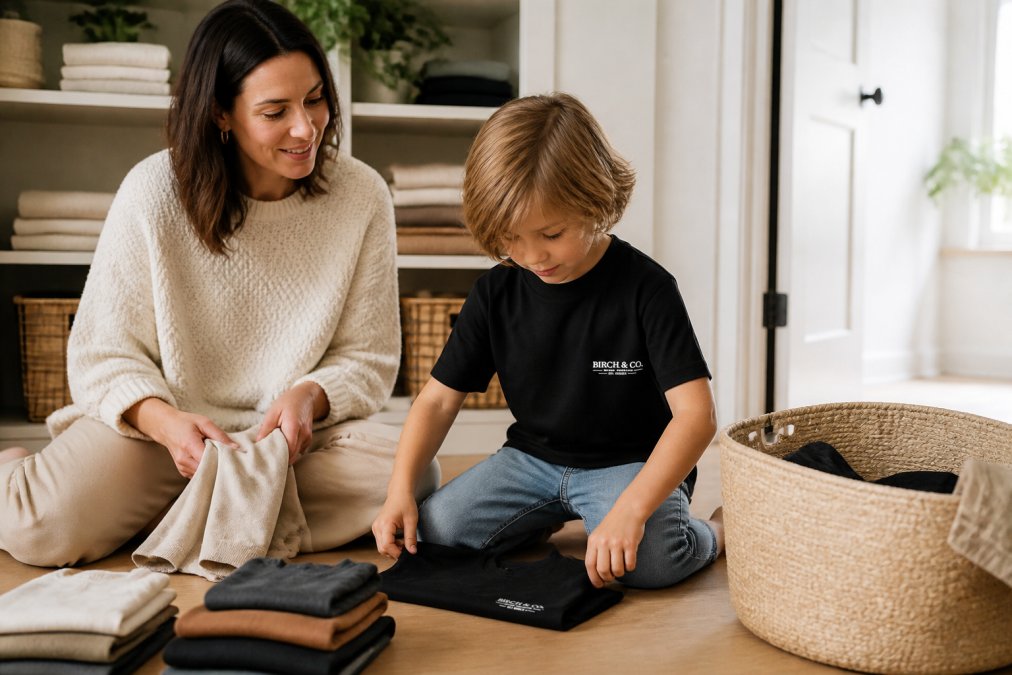
The resale market for kids clothing has exploded. Platforms like Poshmark, Mercari, and Facebook Marketplace make it effortless to sell outgrown pieces. A Birch & Co. t-shirt that cost $35 originally might resell for $18-22, recovering nearly 60% of your investment.
Circular design principles are increasingly integrated into sustainable kids clothing. Brands design pieces with longevity in mind: reinforced seams at stress points, quality zippers that don't fail, and timeless designs that don't date quickly. This intentional durability engineering enables pieces to survive multiple children and resale cycles.
A single piece worn by three children instead of one reduces manufacturing impact by 66%. Extending garment life from one year to five years reduces annual textile waste by 80%. For families committed to sustainability, resale and circularity represent the most impactful lever available.
For practical implementation, photograph outgrown pieces in good lighting, describe condition honestly, and price competitively. Birch & Co. pieces hold value better than trend-driven alternatives due to their durability and timeless design.
Choosing sustainable kids clothing doesn't require perfection, it requires intentionality. Start with a capsule wardrobe of quality basics, prioritize durability and timeless design, and embrace resale and hand-me-downs as core strategy. Pieces from Birch & Co. are engineered for exactly this approach: designed to last through multiple children, timeless enough to avoid dating, and durable enough to justify their price through cost-per-wear analysis.
The shift from fast fashion to sustainable kids clothing is simultaneously better for your family budget, your child's skin health, and the environment. When doing the right thing also saves money and improves outcomes, it's worth the small upfront effort to build the habit.
Frequently Asked Questions
Q: What makes sustainable kids clothing different from regular children's clothing?
A: Sustainable kids clothing prioritizes organic materials like GOTS certified organic cotton and bamboo viscose, ethical manufacturing practices, and durability designed to last through multiple children or seasons. Unlike fast-fashion alternatives, these pieces are made with non-toxic dyes, minimal chemical processing, and transparent supply chains. They're engineered for longevity, thicker fabrics, reinforced seams, and timeless designs that don't fade quickly, reducing the need for constant replacement.
Q: How do slow fashion benefits for families translate to real savings?
A: Slow fashion reduces your cost-per-wear significantly. A $40 organic cotton kids t-shirt worn 100+ times costs $0.40 per wear, while a $10 fast-fashion shirt worn 15 times costs $0.67 per wear. Sustainable pieces resist pilling, fading, and shrinking, so they maintain quality through hand-me-downs to siblings or resale. Families also spend less time shopping, replacing damaged items, or managing excessive inventory, saving money and mental energy.
Q: Why should I choose organic cotton kids clothes over synthetic blends?
A: Organic cotton kids clothes are hypoallergenic, gentle on sensitive skin, and free from pesticide residues used in conventional cotton farming. They breathe better than synthetics, regulate temperature naturally, and feel softer against delicate skin. GOTS certified organic cotton is grown without synthetic fertilizers or genetically modified seeds, making it safer for children and gentler on the environment. Synthetic blends can trap heat and moisture, increasing the risk of irritation.
Q: How do I build a kids capsule wardrobe that actually works?
A: Start with 5-7 neutral basics in organic cotton or natural fibers: t-shirts, long sleeves, and a hoodie in black, white, grey, or cream. Add 2-3 bottoms (joggers, denim) in the same neutral palette. Choose pieces with unisex, oversized fits so they work across genders and grow with your child. Prioritize quality over quantity, each piece should mix with at least three others. Select timeless silhouettes (crew necks, drop shoulders) that won't feel dated in two years.
Q: What certifications should I look for when buying sustainable kids clothing?
A: Look for GOTS (Global Organic Textile Standard) certification on organic cotton items, it verifies organic farming and ethical manufacturing. Fairtrade certification ensures fair wages and safe working conditions. Check for non-toxic dye certifications like Oeko-Tex, which tests for harmful chemicals. Transparent brands disclose their supply chain and manufacturing locations. Ask whether the brand uses pre-consumer textile waste reduction or closed-loop production systems to minimize environmental impact.
This article was written using GrandRanker