

Table of Contents
- Step 1: Run a Full Closet Inventory and Wardrobe Audit
- How to Declutter Your Closet Without Regret
- Define Your Style Vision Before You Shop
- Minimalist Wardrobe Essentials for Women
- Your Minimalist Capsule Wardrobe Checklist
- Fabric Quality, Cost-Per-Wear, and Buying Less
- Build Your Minimalist Wardrobe with Intention
- Conclusion
Last Updated: August 17, 2026
A minimalist wardrobe is a curated collection of high-quality, versatile pieces that work together intentionally, eliminating the daily friction of "nothing to wear" by ensuring every item earns its place. This guide walks you through every step, from auditing what you own to understanding cost-per-wear, so you can build a wardrobe that lasts years, not seasons.
Most people don't have too few clothes. They have too many of the wrong ones. The goal here isn't deprivation; it's clarity.
Step 1: Run a Full Closet Inventory and Wardrobe Audit
A wardrobe audit is the foundation of any successful minimalist wardrobe. Pull everything out, lay it flat, and look at what you actually own before you buy a single new piece. This step alone tends to be the most uncomfortable and the most useful.
The purpose isn't to feel guilty about past purchases. It's to gather honest data about your existing wardrobe so every decision going forward is intentional rather than reactive.
Sort by Category, Not by Season
Most people sort clothes by season, which hides the truth. Sort by category instead: all tops together, all bottoms together, all outerwear together, all shoes together. This reveals duplication patterns immediately. You'll often find seven black long-sleeve tops and zero quality trousers, or four nearly identical grey crewnecks and nothing that works for a meeting.
Once you can see the full picture of each category, patterns become obvious. That's the point.
Apply the 90-90 Rule to Cut Decisively
The 90-90 rule asks two questions about each item: Have you worn it in the last 90 days? If not, will you wear it in the next 90 days? If the answer to both is no, the item doesn't belong in a functional wardrobe.
This rule is deliberately strict. Sentimental exceptions exist, but they should be rare. The closet inventory step only works if you're willing to act on what it reveals.
| Category | Keep If | Remove If |
|---|---|---|
| Tops | Worn in last 90 days, fits well | Duplicated, ill-fitting, faded |
| Bottoms | Versatile, comfortable, flattering | Never worn, wrong silhouette |
| Outerwear | Functional for climate, layerable | Season-specific only, worn out |
| Shoes | Worn regularly, pairs with 3+ outfits | Uncomfortable, single-occasion |
| Accessories | Completes multiple looks | Impulse buys, rarely touched |
How to Declutter Your Closet Without Regret
The biggest mistake in decluttering is doing it too quickly. Regret usually comes from removing items before you've defined what you actually need. Complete the audit first, then declutter with a clear style vision in mind.
A practical approach: create three piles. Keep, remove, and a "hold" pile for items you're genuinely unsure about. Box the hold pile, store it for 60 days, and donate anything you didn't retrieve.
Sustainable Disposal: Where Unwanted Clothes Actually Go
Sustainable fashion starts with how you exit clothing, not just how you enter it. Many people don't realize that textile waste is a significant environmental issue, and simply bagging clothes for the bin is the worst outcome.
Better options exist. According to Environment and Climate Change Canada's textile waste guidance, Canadians discard millions of kilograms of textiles annually, most of which ends up in landfill. Practical alternatives include:
- Donate to local shelters, community organizations, or textile-specific charities that accept worn items
- Sell through peer-to-peer platforms for items in good condition
- Repair or repurpose damaged pieces into cleaning cloths, quilts, or craft materials
- Textile recycling programs offered by select municipalities and some retailers who collect garments for fiber recycling
Slow fashion isn't just about buying less. It's about closing the loop on what you already own.
Define Your Style Vision Before You Shop
The most common reason minimalist wardrobes fail is shopping before defining a style vision. People declutter, feel the empty space, and immediately refill it with whatever is on sale. The result is a slightly smaller version of the same problem.
A style vision board doesn't need to be elaborate. Collect 10-15 images that represent how you want to feel in your clothes, not just how they look. Notice patterns: are the images mostly structured or relaxed? Monochromatic or textured? Casual or polished? That pattern is your style direction.
Once you have a direction, set wardrobe boundaries. A wardrobe boundary is a simple rule that governs what enters your closet: "I only buy neutral colors," or "every item must work with at least three others I already own." These rules prevent impulse buying and keep the capsule system coherent over time.
This is where intentional shopping begins. Without a defined style vision, every purchase is a guess.
Minimalist Wardrobe Essentials for Women
Minimalist wardrobe essentials are the core layers that form the backbone of a capsule collection: pieces that are versatile, seasonless where possible, and built to last. For women, a functional starting point typically includes:
- A white or cream fitted tee in natural fiber
- A striped or solid long-sleeve top
- A quality crewneck or lightweight knit
- Dark, well-fitted straight-leg or slim trousers
- Dark denim in a clean, minimal wash
- A tailored blazer in a neutral color palette (black, camel, or navy)
- A midi skirt or dress that transitions across seasons
- A quality white button-down shirt
- Ankle boots and a clean white sneaker
- A structured tote and a smaller crossbody
This isn't a rigid formula. It's a framework. The exact pieces shift based on lifestyle, climate, and personal style, but the principle holds: every item should be a wardrobe staple that earns its place through versatility.
Body Type and Fit: Why Silhouette Matters More Than Size
Fit is the most underrated variable in a minimalist wardrobe. A well-fitted piece in a basic fabric looks more polished than an expensive item that doesn't suit your proportions. This is the part most guides skip entirely.
The goal is to understand your silhouette and shop for fit and silhouette rather than size labels, which vary significantly between brands. A few principles that hold across body types:
- Tailoring a well-made piece to fit precisely costs far less than buying a new one
- High-waisted cuts tend to create a longer leg line across most proportions
- Structured shoulders add definition; dropped shoulders soften and relax a look
- Fabric weight matters: heavier fabrics hold shape, lighter ones drape
According to the Textile Labelling and Advertising Regulations administered by the Competition Bureau of Canada, garment sizing and labelling standards in Canada require accurate fiber content disclosure, which helps consumers evaluate fit and fabric behavior before purchasing. Knowing fiber content is part of understanding how a piece will fit over time.
Your Minimalist Capsule Wardrobe Checklist
A minimalist capsule wardrobe checklist gives you a concrete target to work toward. The following covers a functional 30-35 piece capsule that handles most everyday occasions:
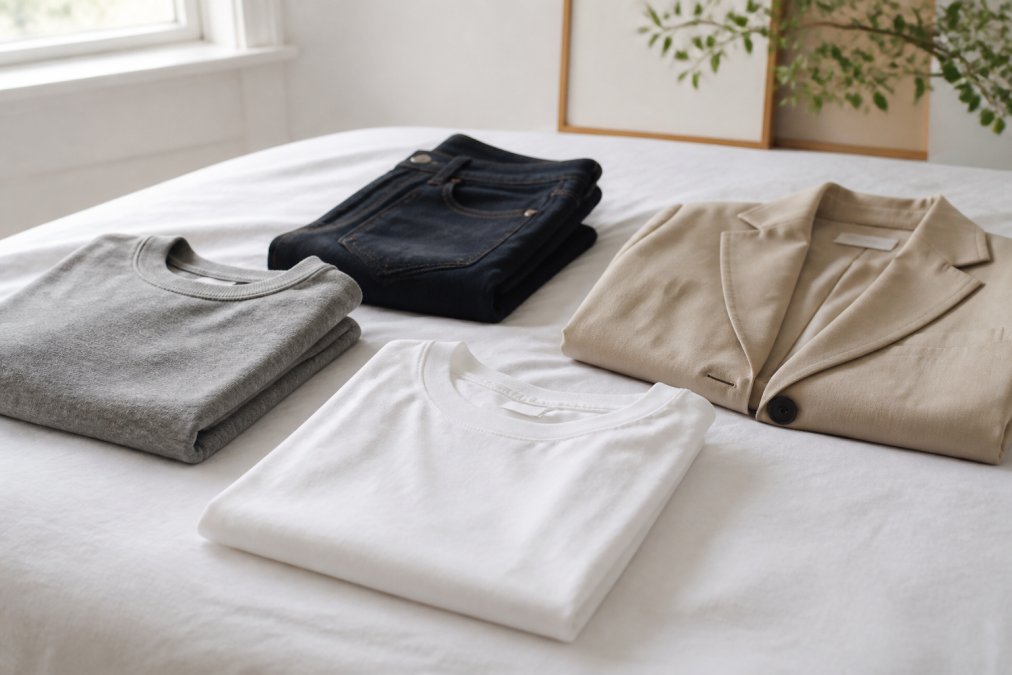
Core Layers:
- 3 quality tees (white, grey, navy or black)
- 2 long-sleeve tops in neutral tones
- 2 knits or crewneck sweaters
- 1 quality button-down shirt
Bottoms:
- 2 pairs of trousers (one tailored, one relaxed)
- 1-2 pairs of dark denim
- 1 skirt or casual dress
Outerwear:
- 1 structured blazer or jacket
- 1 coat suited to your climate
- 1 casual layer (denim jacket, overshirt, or quilted vest)
Footwear:
- 1 clean white sneaker
- 1 ankle boot or loafer
- 1 sandal or flat for warmer months
Accessories:
- 1 structured everyday bag
- 1 casual crossbody or tote
- 2-3 minimal jewelry pieces
Seasonal Transition Strategies for a Capsule System
Seasonal rotation is where many capsule wardrobes break down. The solution is to design for transition rather than treating each season as a separate wardrobe problem.
Base your capsule around pieces that work across at least two seasons: a lightweight merino knit works from September through April with the right layering. Outerwear does the heavy lifting during transitions. A good quality coat worn over a summer dress extends that piece by two months on either side.
Practically, this means:
- Storing off-season items in breathable cotton bags (not plastic bins, which trap moisture and damage natural fibers)
- Doing a mini wardrobe audit at each seasonal shift rather than a full overhaul
- Adding one or two seasonal-specific pieces per year rather than rebuilding from scratch
The capsule system rewards patience. Each season, you refine rather than restart.
Fabric Quality, Cost-Per-Wear, and Buying Less
Textile quality is the variable that separates a minimalist wardrobe that lasts from one that needs replacing every two years. The most durable natural fibers for everyday wear include cotton, linen, merino wool, and silk blends. Synthetic blends can extend the life of natural fibers and improve wrinkle resistance, but all-synthetic garments tend to pill faster and feel less comfortable against skin over time.

Cost-per-wear is the most useful framework for evaluating whether a higher-priced piece is worth it. The formula is straightforward:
Cost-per-wear = purchase price ÷ number of times worn
A $40 fast-fashion top worn four times before it fades costs $10 per wear. A $180 quality merino crewneck worn 120 times over three years costs $1.50 per wear. The math makes the case for investment pieces better than any marketing claim.
According to the Waste Reduction Week in Canada resource library, Canadians are increasingly aware of the environmental cost of fast fashion, and cost-per-wear thinking aligns directly with slow fashion values by reducing total consumption.
Garment care also extends clothing longevity significantly. Washing on cold, air-drying instead of machine-drying, and storing knitwear folded rather than hung prevents stretching and fiber damage. These habits cost nothing and double the lifespan of quality pieces.
Build Your Minimalist Wardrobe with Intention
The final step is the ongoing practice. Building a minimalist wardrobe isn't a project you complete; it's a habit of intentional shopping that replaces the reflex of impulse buying.
A few principles that sustain a capsule wardrobe over time:
Repeat outfits without apology. Outfit repetition is a feature, not a flaw. The most stylish people wear the same pieces constantly because those pieces fit well, feel good, and reflect their actual style. Breaking fashion rules around repetition is central to the minimalist aesthetic.
Shop with a list. Before any purchase, check it against your wardrobe boundaries and your capsule wardrobe checklist. If it isn't replacing something worn out or filling a genuine gap, it doesn't belong in the cart.
Wait before buying. A 48-hour rule on any non-essential purchase eliminates a significant portion of impulse buying. Most items feel less urgent after two days.
Invest in tailoring. A tailor can transform a well-made piece that's slightly off into something that fits as though it was made for you. Tailoring is one of the most cost-effective investments in a curated closet.
Birch & Co. builds its collection around exactly these principles: timeless design, thoughtful details, and quality that outlasts trends. The pieces in a well-chosen capsule wardrobe should feel as relevant in five years as they do today.
Building and maintaining a minimalist wardrobe takes more discipline upfront than most people expect, but the daily payoff is real. Fewer decisions, more confidence, and clothing that actually lasts. Birch & Co. offers a curated selection of everyday essentials designed with timeless design and lasting quality at the core, making it straightforward to fill the genuine gaps in your capsule without compromising on durability or style. Browse the Birch & Co. collection and start building a wardrobe that works as hard as you do.
Frequently Asked Questions
How many items should be in a minimalist wardrobe?
Most minimalist wardrobes fall between 30 and 50 items total, including tops, bottoms, outerwear, and shoes. The exact number depends on your lifestyle and climate. A capsule wardrobe built around a neutral color palette with versatile, mix-and-match pieces typically needs fewer items to create more outfits. The goal is not a specific count, it is owning only what you wear consistently and nothing more.
What is the 90-90 rule for minimalism in fashion?
The 90-90 rule asks: have you worn this item in the last 90 days, and will you wear it in the next 90 days? If the answer to both is no, it is a strong signal to let the piece go. This rule works well during a wardrobe audit because it cuts through sentimental attachment and forces honest reflection on actual wearing habits rather than theoretical future use.
What are the essential pieces for a minimalist wardrobe?
Core essentials typically include well-fitted neutral basics like white and grey tees, a quality crewneck or knit, dark and light denim, tailored trousers, a versatile button-down, a structured blazer or jacket, and a reliable outerwear piece suited to your climate. For footwear, a clean white sneaker, a leather or leather-look loafer, and one ankle boot cover most occasions. Prioritize natural fibers and timeless silhouettes for the longest clothing longevity.
How do I start decluttering my closet for a minimalist lifestyle?
Pull everything out of your closet first, do not sort in place. Group items by category (tops, bottoms, outerwear) and assess each one against three questions: Does it fit well right now? Have I worn it in the past year? Does it work with at least three other pieces I own? Anything that fails two of the three questions should go. Donate wearable items to local textile drives or consignment shops, and recycle worn-out pieces through fabric recycling programs.
This article was written using GrandRanker